
What is Community Safety?
What Community Safety Actually Means
Community Safety is a proactive approach to protecting people in shared spaces. It is built into a property before anything happens. It is funded by the property owner, designed for the specific environment, and it gives the people already on scene the tools and support to act when something goes wrong.
Community Safety is not a product category. It is not a single device, an app, or a service line. It is a way of organizing safety so that the people present at the moment something happens are part of the response, not bystanders to it.
Most property safety strategies are built around the assumption that the response begins when professional help arrives. Community Safety begins earlier. It begins the second something happens, with the people who are already there.
That shift in timing changes everything.
Why This Category Did Not Have a Name Until Recently
Most property leaders we talk to have never heard the term "Community Safety." They know "public safety." They know "security." They know "emergency response." But the layer between an incident and a trained response, the layer that depends on the people already in the space, has not had a clear definition in the way that public safety does.
The absence of that definition has a cost.
When something is not defined, it does not get budgeted. It does not get specified. It does not get owned. It falls into a gap between security, facilities, risk management, and emergency planning, with each function reasonably assuming another one has it covered.
A proper definition is the first step toward closing the gap. "Community Safety" gives property leaders, designers, and operators a shared language for something they have always intuitively known mattered, but did not have a way to discuss as its own discipline.
This is one reason we believe Community Safety deserves its own conversation. Not as a sub-category of security. Not as a feature of a single device. As its own layer, with its own design principles, its own outcomes, and its own ownership.
Public Safety vs.
Community Safety
Both matter. Both are essential. They are not in competition.
But they are not the same thing.
| Public safety | Community Safety | |
|---|---|---|
| Who runs it | Government and trained responders | The property owner |
| When it activates | After a call for help is placed | The moment something happens |
| Who delivers the response | Police, fire, EMS | The people already in the space, supported by a connected system |
| What it depends on | Dispatch routing, response time, and location accuracy | Visible devices, multilayered alerts, real-time information, and opted-in bystanders |
| What it asks of the property | A way to call out | A way to coordinate inside the property before help arrives |
A useful way to remember the difference: public safety asks, "Who do we call?" Community Safety asks, "How do we help right now?"
Most properties have invested heavily in the first question. Few have built for the second. Community Safety is what fills that second layer.
It is worth saying clearly. Community Safety does not replace public safety. It does not reduce the role of trained responders. What it does is make the minutes before those responders arrive count, so the person who needs help is not alone. The people standing nearby know what to do.
The Gap That Community Safety Fills
On most properties, the time between the moment something happens and the moment trained help arrives is approximately seven minutes. It’s shorter on some properties, longer on others. Multiple gated entrances, large parking structures with several decks, shifting traffic patterns—all of these can extend the window meaningfully.
What happens in those minutes determines a great deal about the outcome.
For cardiac emergencies, immediate bystander action significantly improves the chance of survival. For falls, allergic reactions, mental health crises, and physical altercations, the response from people on scene shapes whether the situation gets better or worse before professional help can take over. The pattern is consistent across emergency types. What bystanders do in the first minutes is often the most decisive variable.
Most bystanders, however, do not act.
Not because they do not care. Most of them want to help. They do not act because they do not have the tools, the information, or the support to act usefully. They do not know exactly where to go. They do not know what equipment is nearby. They do not know whether anyone has been alerted. They do not know whether they are about to make things worse by trying.
Community Safety changes the conditions of that moment. It gives bystanders the information they need to act usefully. It connects them to the people who can help them. It puts the equipment they need within reach. It tells them what to do next.
That is the function of a Community Safety ecosystem.
How a Community Safety Ecosystem Works
A Community Safety ecosystem is a connected system of devices, alerts, and communication tools built into a property. The point is not the individual devices. The point is what happens when they coordinate.
When a device is activated on a property with a Community Safety ecosystem in place, a sequence of things happens at once.
Device trigger. Someone on the property activates the system. They press a button on a blue light station. They open an AED cabinet. They pull a life ring. They use any of the visible safety devices the property has put in place. The activation is the first signal that something is happening, and it does more than just send a single message.
Multilayered alerts. The system does not route the activation to one place and stop there. It alerts multiple parties simultaneously. Audible and visual alerts notify people nearby that an event is underway. The property's security or dispatch team gets a text, call, or radio message with the relevant details. Anyone who needs to know knows immediately.
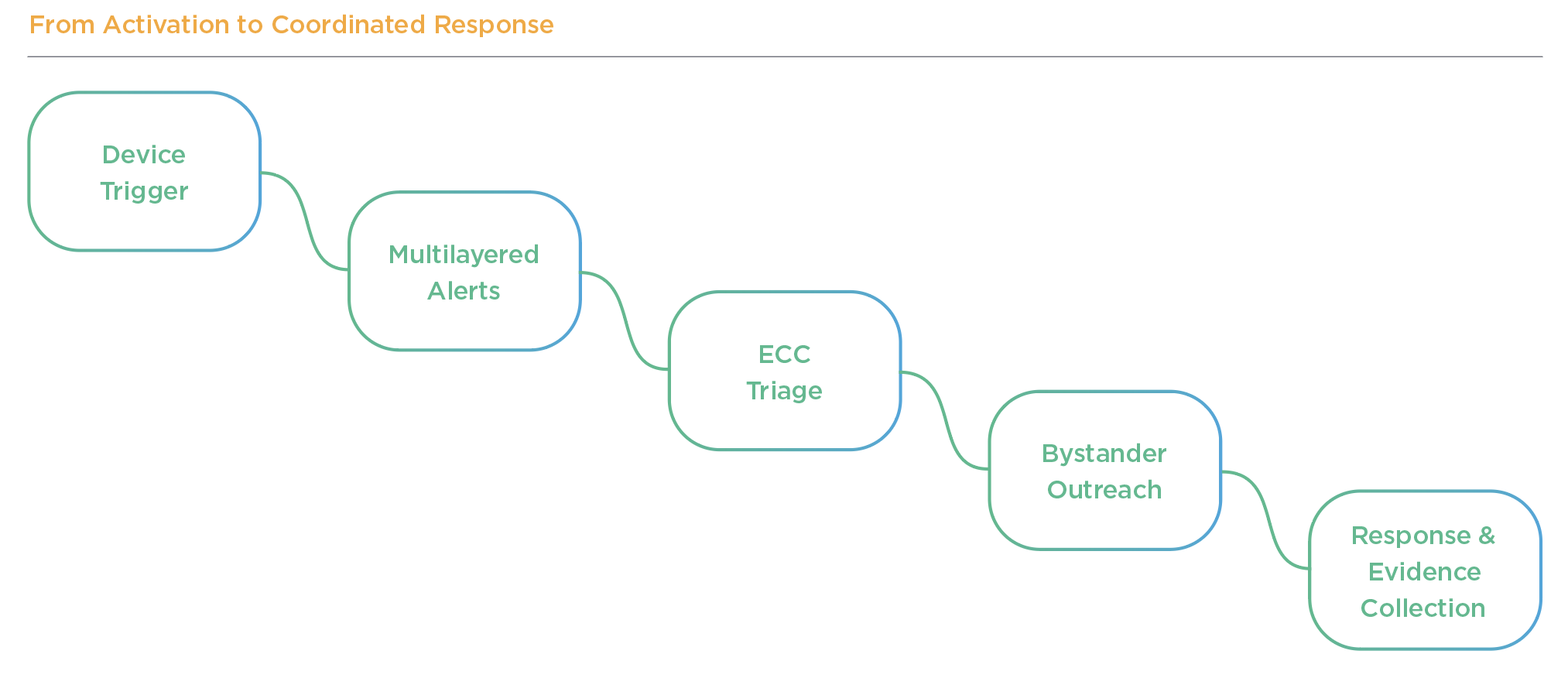
Dispatcher data. Dispatchers receive information that goes well beyond a phone call. They get the exact location, often down to the floor and section. They get live audio from the scene. In many environments, they get video. They can communicate directly with the person on scene. The contextual richness of the information speeds the right response.
Bystander outreach. People nearby who have opted in to receive alerts get a simple text message. Those with relevant training, such as CPR or first aid, are reached first. No app download is required. The system meets bystanders where they already are, on the device they already have in their hand.
Evidence collection. The entire sequence is documented with timestamps, photos, and witness data. This supports follow-up, reporting, and any investigation that follows. It also gives the property measurable evidence that the system worked, which is the foundation of accountability.
This is the difference between a property that has safety equipment and a property that has a safety system. Equipment fires when something is wrong. A system coordinates a response.
Most properties have equipment. Very few have systems. That gap is what Community Safety addresses.
Who Community Safety is for
Community Safety applies to any property where people gather. The scenarios differ by environment, but the underlying need is the same.
Higher education campuses. Large populations, dispersed buildings, late-night foot traffic, and parking structures that students walk through alone all create a particular profile of need. Higher ed has been at the forefront of community-scale safety thinking for decades, partly because the population is young and partly because the campuses are physically open in a way that workplaces are not. Community Safety formalizes what many campus safety teams have been working toward for years.
Healthcare facilities. Hospitals and medical campuses have unique patterns. Patient and visitor populations who are often already in distress. Parking structures with high after-hours use. Entrances that need to remain navigable at all times. Grounds that combine medical urgency with public access. The seven-minute gap is felt acutely in environments where the people on scene may include both clinical staff and visitors with no medical training
Corporate campuses and office complexes. Large workforces in distributed buildings need a way to coordinate response across the property. Corporate environments often have strong public safety partnerships, but the layer between an event and the arrival of help, especially in suburban or campus-style settings, is often where the response is most fragile.
Mixed-use developments and transit hubs. These environments have populations that change hour by hour, day by day. The people in the space at 8 a.m. are not the same people there at 8 p.m. A Community Safety ecosystem accounts for this by relying on the system, not on the assumption that any particular individual will be present.
Municipal properties and parks. Public-facing properties owned by cities, counties, and parks departments serve the broadest range of users. Trailheads, beaches, and parking areas are often physically remote, and dispatch information from those locations is often the least precise. Visible, connected devices fill that gap and give people something to look for when they need it.
The common thread across all of these environments is the same. People gather. Time matters when something goes wrong. The layer between an event and the arrival of help is where outcomes are decided.
Five Signs Your Property Has Equipment But Not a System
Most properties have invested in safety equipment over many years. Cameras, call stations, perhaps an emergency communication app, or an integrated mass notification platform. The question is whether those pieces are connected.
Five signs to look for.
Your cameras record, but your team does not get an alert when something happens. Recording is documentation. Alerting is response. The two are not the same.
Your call station connects to a dispatcher, but the people nearby have no idea an event is in progress. A call from one device to one dispatcher leaves everyone else blind.
Your safety app works, but only if someone has downloaded it, has signal, and remembers to open it. App-based safety is contingent. Visible, networked devices are persistent.
When a device is activated, your team gets information, but bystanders get nothing. The people closest to the event are usually the people who can do the most. They cannot act on information they do not have.
You cannot prove that your safety spending is producing measurable outcomes. If you cannot show what your safety equipment did the last time something happened, you have not built a system. You have built an inventory.
If any of these sound familiar, your property has equipment without a connected system. That gap is fixable. We will go deeper on each of these signs in a follow-up piece.
One Community Safety idea every two weeks. Written by David Cook.
Where Community Safety Came From
Code Blue has been building safety devices for public spaces for nearly four decades. We pioneered the blue light emergency communication tower that has become a standard feature on higher education campuses across the country. For most of that time, the work was about a single device doing a single job well: connecting the person who pressed the button to a dispatcher.
That mattered, and it still does.
After years of watching how those devices got used, and how the moments around an activation actually played out, a question started to surface. The device did its job. The people standing twenty feet away did not. They were not part of the response. The system did not include them.
Community Safety is the answer to that question. It is the evolution of forty years of safety device work into a coordinated ecosystem that supports everyone on scene, not just the person pressing the button.
Community Safety reflects a belief. The people in a space are part of its protection. When they have the right tools and the right support, they can act. They want to act.
Most of the work of Community Safety is in removing the barriers that prevent people from acting on what they already want to do.
What to do this week
If you are a property leader reading this, the most useful thing you can do this week is take fifteen minutes to walk one part of your property and ask one question.
If something happened here right now, what would actually happen in the next five minutes?
Be specific. Pick a real spot. The third level of the parking deck. The trailhead at the back of the campus. The lobby at 7 p.m. on a Tuesday. Walk the space. Look at the equipment that is in place. Ask yourself who would get the alert. Who would know where to go. What the people standing fifteen feet away would do. What they would have to work with.
The answers will tell you whether your property has a system or just inventory.
If you want a more structured way to do this, we built a Community Safety Readiness Assessment for exactly this purpose. Eight questions. Two minutes. A clear picture of where you stand and where to go next.
FAQ
-
Community Safety is a proactive approach to protecting people in shared spaces. It is built into a property before anything happens, funded by the property owner, and designed to give the people already on scene the tools to act when something goes wrong.
-
Public safety is the system run by the government and trained responders. It activates after a call for help. Community Safety is the layer between the moment something happens and the moment those responders arrive. Both matter. They are complementary, not competitive.
-
Any property where people gather. Higher education campuses, healthcare facilities, corporate campuses, mixed-use developments, transit hubs, and municipal properties are common environments.
-
No. Community Safety is a way of organizing safety on a property so that visible devices, multilayered alerts, dispatcher data, and the people already on scene work together as a connected system.
-
Most properties have safety equipment. Few have a connected system. If your cameras record but no one gets alerted, your call station connects to a dispatcher, but bystanders are blind, your app only works if someone downloaded it, your team gets information but bystanders get nothing, or you cannot prove your safety spending produces measurable outcomes, your property is in the gap that Community Safety fills.

David Cook, CEO
Code Blue Corporation
David Cook writes about Community Safety at Code Blue, where he leads the conversation about the layer of property safety that exists between the moment something happens and the moment trained help arrives. He publishes a newsletter on the subject every two weeks. You can subscribe at: https://go.codeblue.com/safe_community_spaces