
The Flag Problem
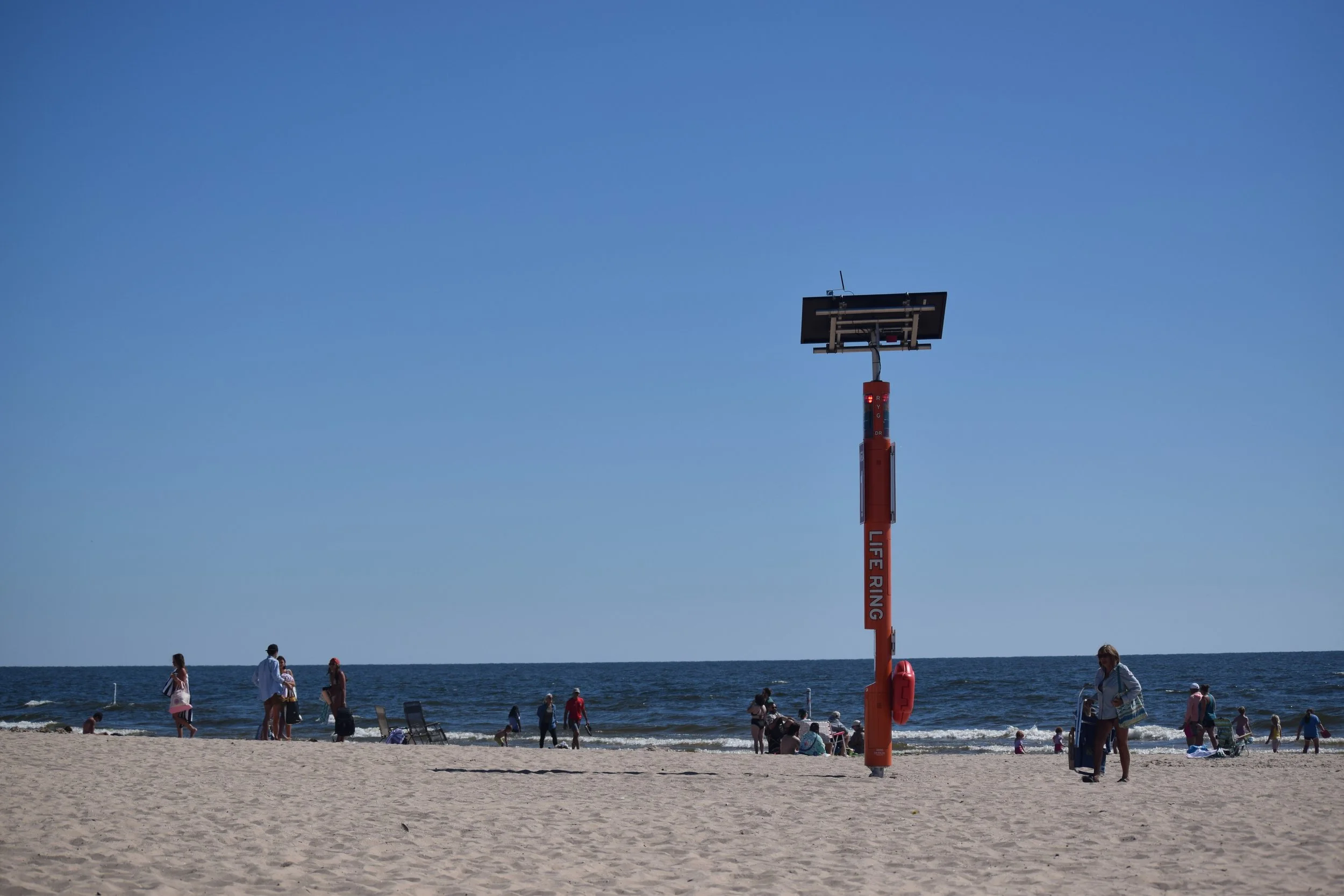
At Grand Haven State Park, SwimSmart Technology LLC, the Michigan Department of Natural Resources and Code Blue replaced hand-changed beach warning flags with 8 automated, solar-powered and 4 automated, shore-powered safety towers. The warning lights only look simple. Behind them sits nearly a decade of work on a display that stays legible in broad daylight, runs on a strict power budget and survives one of the harshest environments on the Great Lakes. And the display is one piece of a system designed end to end for this shoreline, which came down to three problems solved with trenching off the table.
Installation on open sand, without trenching a protected beach
Power that holds through the darkest, least sunny weeks of the year
Connectivity with no conventional wide area network anywhere on site
Here is how each was solved, and one thing the technology is careful not to claim.
For as long as public beaches have posted swim conditions, the system has worked the same way. Someone checks the water, walks out to the pole and changes the flag by hand.
It is a workable system, and a hotly debated one, with two built-in limits. It depends on a person being available, and it is only as current as that person's last trip to the pole. Conditions on the water can turn in an hour. A green flag that was accurate at 9 a.m. may or may not be true at 9:45.
Who set out to solve it?
That is the problem SwimSmart Technology LLC was founded to solve.
The company started at a Great Lakes water safety conference in Sheboygan, Wisconsin, in 2017. Engineering students from Michigan Technological University's SENSE program were there presenting a remote-controlled life ring concept when they heard about the flag problem from the people living it. They set out to build an electronic replacement, an automated warning display that could be updated remotely and, eventually, update itself from National Weather Service forecasts.
Over the next several years the concept moved from student prototype to production system. SwimSmart refined the warning logic and the automation, and partnered with Code Blue for a rugged, self-contained tower platform built to survive continuous exposure on a Great Lakes shoreline. The collaboration produced the first large-scale installation of its kind.
In May 2024, SwimSmart, the Michigan Department of Natural Resources and Code Blue® unveiled 12 electronic, web-enabled safety towers at Grand Haven State Park on Lake Michigan. Eight sit on the beach with electronic light displays that mirror the familiar red, yellow, green and double-red flag system, broadcast prerecorded messages about changing weather and carry a sensor-monitored life ring. Four more sit along the sidewalk with two-way communication to a 911 dispatcher, loudspeaker broadcasting and video monitoring. Five alarm stations at key facilities around the park round out the installation. When a life ring is deployed, 911 and park rangers are alerted at the same time, the alarm stations sound and rangers are directed to the location.
The project's total cost was publicly reported at $570,000, funded largely through DNR Parks and Recreation capital outlay with a $200,000 grant from the Michigan Economic Development Corporation.
Here is what had to be solved to get there.
1. How do you install on a beach you cannot dig up?
A beach is one of the least forgiving places to install connected equipment.
The devices have to go where the people are, out on open sand, far from the buildings where power and network already exist. The conventional answer is to trench. Dig a path, lay conduit, pull cable, restore the surface. On a state park shoreline, every step of that runs into an obstacle. Environmental regulation. Protected dune and shoreline habitat. A construction schedule imposed on a beach that has a season. And the site itself is one of the hardest installation environments on the Great Lakes. Shifting sand, high water and wind, ice and snow.
The cost of reaching a remote location is rarely the equipment at the end of the run. It is the labor, cable, conduit, burial depth, permitting and restoring the ground afterward. But at Grand Haven, cost was never the whole case. Working open sand takes tracked equipment. Concrete does not do well in water. A buried line on an eroding shoreline will eventually be exposed. Trenching was unsuitable here, and the team had to build past it.
So theymade each tower self-sufficient. SwimSmart and the DNR specified standalone solar-powered towers that make their own power on site and connect over cellular and a long-range radio mesh, and Code Blue supplied them. No trenching. No conduit. No underground cable runs across the beach.
That decision solved the infrastructure problem and immediately created a structural one. Each tower stands 15 feet tall. With its dual solar arrays mounted, the assembly reaches 21 feet and weighs nearly 1,200 pounds, and it still had to stand in open sand. The DNR set the terms. The foundation had to be semi-permanent, so a tower could be pulled for maintenance or moved temporarily for sand nourishment work, and the crew had to be able to do it with equipment the park already owned. Everything had to hold to a safety factor of two.
Code Blue engineered both the foundation and the way the towers are handled. In place of excavation and poured concrete footings, the foundation is a three-section, 15-foot ground screw, hot-dip galvanized end to end to last in wet sand and clay. To certify it, Code Blue partnered with Soils and Structures, a Grand Rapids firm whose civil and construction engineers signed off on the system to that safety factor across Great Lakes soil conditions, rated for winds up to 120 mph. Aspecialized handling system was engineered, so that the whole assembly can be raised and laid down flat for storage or service, again with equipment a park crew can run.
That combination did three things at once for the park. It removed the largest cost driver, it shortened the construction timeline and it left the shoreline undisturbed. It also gave the project a mounting and power model that can be reused anywhere infrastructure was never going to reach.
2. How do the towers stay powered off-grid?
An automated warning display has an unusual duty cycle. It has to be right continuously, and it has to be right during exactly the weather that produces the least sunlight.
That is the whole design problem in one sentence. The system's hardest days are its darkest days.
Code Blue's standard solar platform is already built with more headroom than most, a 180-watt array where other available solutions provide 45 to 145 watts, paired with 147.2 amp hours of sealed gel batteries. Grand Haven asked for more than the standard build. It asked for a different class of margin.
To keep an active water-rescue warning display running on the Lake Michigan shoreline, the team scaled the power system up to an 800-watt solar array paired with a 24-volt, 195.2 amp-hour gel battery bank that holds nearly 4.7 kilowatt-hours of stored energy. On this beach, that capacity is not a luxury. Grand Haven's least productive weather and its most consequential weather are the same weather.
The battery chemistry earns its place here too. Solar photovoltaic gel batteries are maintenance-free, tolerate deep discharge and recovery, hold up against temperature extremes, resist vibration and self-discharge slowly. The electrolyte has a putty-like consistency, so it will not spill acid. And unlike lithium-based chemistries, sealed gel does not carry the same thermal-runaway or water-reactivity risk, and it holds up in harsh, moisture-heavy conditions without the elaborate weatherized enclosures those chemistries can need.
On a beach, a few steps from a very large body of water, that last detail is worth more than a spec line suggests.
3. How do the towers connect and update themselves?
Power keeps the tower alive. The network is what makes it a warning system rather than a sign.
The automation SwimSmart designed depends on the towers receiving updates from the National Weather Service and real-time input from the DNR, through the Beach Commander software application. It also depends on an immediate, multi-path emergency notification the moment a life ring cabinet is opened. That requires reliable connectivity at the actual location on the beach, and no one was going to run a conventional wide area network across the sand.
The system works in three layers.
The eight water-rescue towers on the sand, the Code Blue SS-1, which SwimSmart calls the RingStation 360, talk to each other and to a base station over a long-range radio mesh network, a rugged link that needs no cabling run between towers.
The four Code Blue CB-1sd towers along the sidewalk, each with audio paging and an overhead pan-tilt-zoom camera, connect back through dedicated fiber-optic cable run alongside the parking lot to SwimSmart's hub.
At that hub sits the on-site head-end, the local brain of the system, made up of a phone switch, a network switch, a video management server and a router. From there, Code Blue feeds the voice path into the radio mesh and uses the Code Blue Cloud, through gateways onto the public phone network, to reach the Ottawa County
Emergency Communications Center three ways at once.
An automated voice call telling dispatchers a water rescue is underway and which tower set it off
A text message carrying the same information
A live pan-tilt-zoom camera feed, with control, so dispatchers can see the scene and support the response
The moment a life ring cabinet is opened, a coordinated set of local and remote actions begins. The tower itself sounds a loud tone and starts flashing. The five alarm stations at key facilities around the park, also on the radio mesh, sound and flash to show that a rescue is underway and which tower triggered it. Push notifications go out through the Beach Commander app on DNR staff phones. Every tower carries an assigned area and number, so staff can orient in seconds. The result is a near-simultaneous concert of on-tower, on-site and remote alerts that reaches park staff, the people nearby and the county emergency center, without anyone having to place a call.
Because the system is cloud-connected, property owners and integrators also get continuous health monitoring, device status and diagnostics. For a safety device sitting alone on a beach, that answers the question every owner should be asking. How would we know if it stopped working? Not from an incident report.
Which brings the beach back to where this started. The warning that once had to be walked out and changed by hand now updates itself in the same minute the water does, and sets a full response in motion.
What the technology is, and what it is not
Grand Haven is a serious place to install a safety system. The Great Lakes Surf Rescue Project counted 85 drownings in the Great Lakes in 2023, and nearly half of all Great Lakes drownings occur in Lake Michigan. That is the context the project was built in, and it is the reason the DNR, SwimSmart and Code Blue took the reliability questions as seriously as they did.
It is also a reason to be careful about what gets claimed.
Dave Benjamin, co-executive director of the Great Lakes Surf Rescue Project, is not affiliated with the project, and he told Bridge Michigan plainly: "We're never going to stop saying they should bring back the lifeguards."
He is right, and the people who built this system say something close to the same thing. Jacob Soter, SwimSmart's founder and CEO, and the 2024 Great Lakes Water Safety Superhero of the Year, put it this way: "It's kind of like a fire alarm system, which can prevent some fires. But at the end of the day, our alarm systems didn't get rid of firefighters."
That analogy is the honest frame for all of this. A fire alarm buys the fire department time and makes sure someone knows. In the same way, an automated warning tower keeps the beach's warning accurate in real time, gives staff a way to speak to everyone at once and puts a life ring and a direct line to a dispatcher within reach of whoever is standing closest. Not one of them is a substitute for the trained responder.
Andrew LundBorg, the Grand Haven State Park supervisor, put the practical gain simply. "It gives us a much broader voice to be able to communicate with people on the beach."
Where else does this apply?
Very little of what made Grand Haven work was specific to a beach.
A location the utility does not reach. Ground you cannot dig. Equipment that has to keep working through the conditions that matter most. A network requirement in a place with no network. Those constraints show up on campuses, in parks, along trails and transit corridors, in parking structures and at property edges everywhere.
Solving them starts earlier than most people expect, in the conversation about what the site actually requires rather than what the catalog offers.
Working through a location like this? Code Blue partners with integrators, property owners and specifiers from the first walkthrough forward.

David Cook, CEO
Code Blue Corporation
David Cook writes about Community Safety at Code Blue, where he leads the conversation about the layer of property safety that exists between the moment something happens and the moment trained help arrives. He publishes a newsletter on the subject every two weeks. You can subscribe at: https://go.codeblue.com/safe_community_spaces
Gabrielle Nelson, "Lake Michigan beach goes high-tech to curb drownings, rip tides," Bridge Michigan, May 21, 2024. https://bridgemi.com/michigan-environment-watch/lake-michigan-beach-goes-high-tech-curb-drownings-rip-tides/