
The Solar Considerations Guide
What to weigh before you specify solar for emergency communications
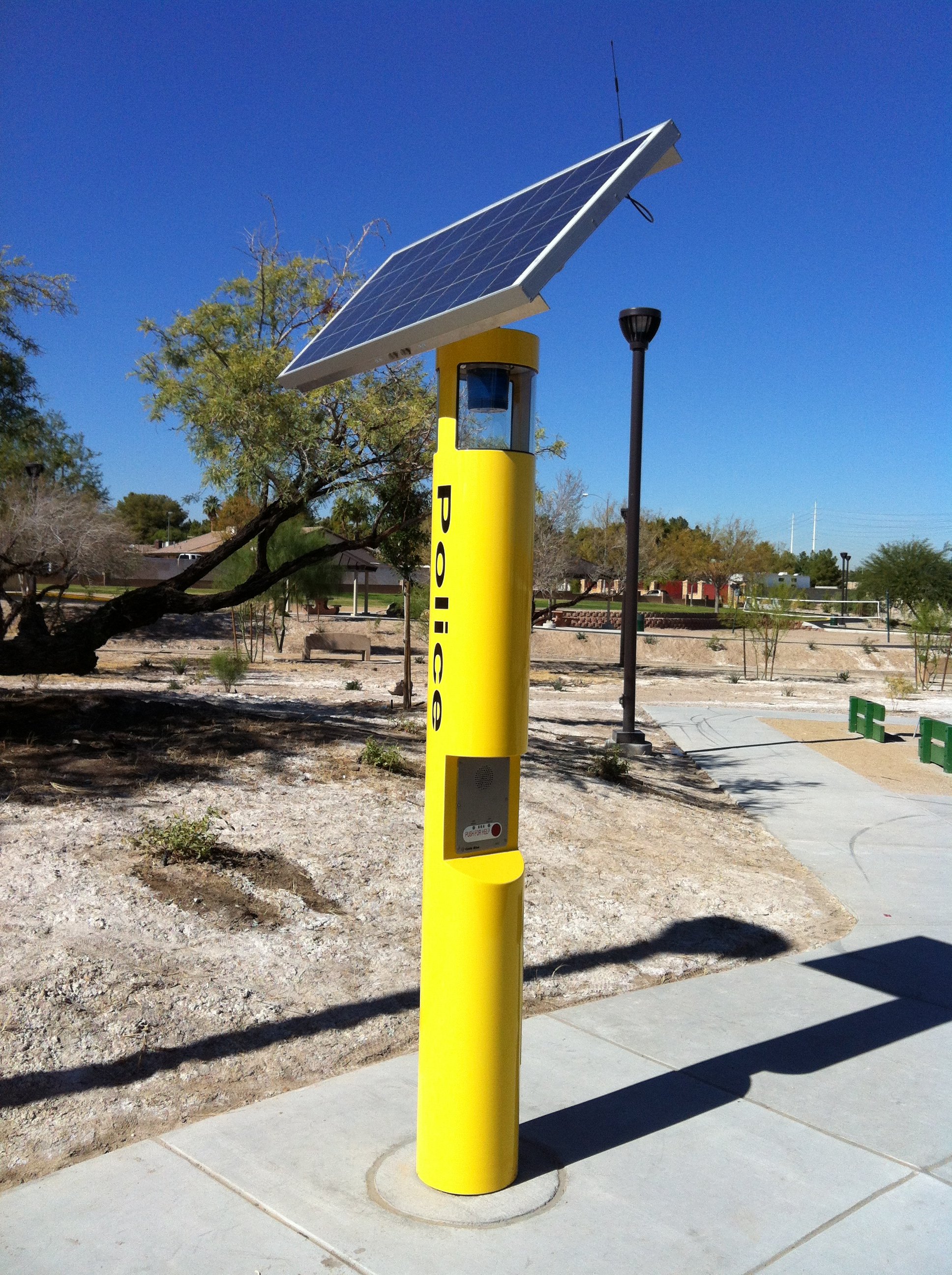
Solar is the right way to power emergency communications almost anywhere the utility does not already reach, and specifying it on price alone is how good projects go wrong. Six questions decide whether a solar tower actually does its job, and this guide works through each one.
How much power do you need, and for how long on the worst day of the year?
What does reaching that location really cost, once the site work is counted?
What else is going on that pole in five years?
What does the site receive in its darkest month?
What network will it use, verified on site?
Who is watching it once it is installed?
This is a how-to guide, written for the integrators, property owners, and specifiers who have to make the call. It is not a spec sheet.
1. Are all solar blue light towers the same?
Two towers can both be described as solar-powered and behave nothing alike.
There are two big numbers that matter, and neither one usually makes it into a bid comparison. The first is how much power the panel can generate. The second is how much energy the system holds when the panel is generating nothing.
Start with what you are actually powering, and for how long. A single emergency phone on a quiet greenway has a very different profile from a tower on a transit platform that answers calls, broadcasts announcements, and streams video. Emergency communications are unusual that way. The device sits nearly idle for months, then has to perform at full draw during the exact event that made you buy it, which may also be the day the weather is worst.
That is the design condition: not the average day, but the extraordinary days when conditions are at their worst.
Then compare across five dimensions, not one.
| What to compare | The question to ask |
|---|---|
| Power generation | How many watts does the panel produce, and at what tilt and orientation? |
| Energy storage | How much usable energy sits in the battery bank, and what chemistry? For how long? |
| Reliability | Will it operate in extreme temperatures? What happens through a week of overcast? |
| Cost to install | What budget does the mounting, foundation, and site work actually require? |
| Cost to maintain | How often does someone have to perform maintenance, and what are the associated costs? |
Price alone will sort these systems into a purchase order that has very little to do with how they will perform in year four.
For reference, here is where Code Blue’s® sits. The CB 1-w solar tower carries a 200-watt panel and 147.2 amp-hours of sealed gel batteries, holding almost 1,800 watt-hours in the bank. Code Blue's comparison of the category puts other available solutions at 45 to 145 watts. The tower is rated from minus 40 to 140 degrees Fahrenheit and certified to UL 62368-1.
| Feature | Code Blue CB 1-w | Other Category Solutions |
|---|---|---|
| Array Wattage | 200 watts | 45 - 145 watts |
| Energy Storage | 147.2 Ah / 2,000+ Wh | Not specified |
| Temperature Rating | -40°F to 140°F | Not specified |
| Certification | UL 62368-1 | Not specified |
Those figures are not there to win a spec-sheet contest. They are there so the system still answers on the fourth gray day in February.
2. Is solar cheaper than trenching power to a remote location?
This is where most solar conversations actually begin, and where a surprising number of them end.
Property owners look at a remote location, get a number for trenching power and network out to it, and abandon the project. Others look at the price of a solar tower against a conventional one, see a higher figure, and stop there. Both are ignoring half the story.
The equipment is rarely the expensive part. What drives the cost of reaching a remote location is the site work around it. Labor rates vary by region and by crew availability. Fiber prices out differently than copper. Conduit grade and burial depth are set by code and by whatever is already in the ground. Rock, water, a roadway, or protected land each add a problem of their own. Then come the permitting fees, and the cost of putting back everything you dug up along the way.
None of that appears on a tower quote. All of it lands on the project.
There is a distance where the two paths cross. Code Blue's Director of Sales, John Plooster, has put it plainly in the company's Ask the Experts series:
"If your Help Point is ~200 feet or further from a power and communications source (connected with buried cables and conduit), you can save so much money and time using solar panels and cellular IP instead. At Code Blue, we like to say, No Power, No Network, No Problem!"
Past roughly 200 feet, the savings do not just appear; they compound. Every additional foot is more labor, more conduit, more restoration. The solar system's cost, meanwhile, is essentially fixed the day it ships.
Then look past year one. Total cost of ownership on a system like this is set by how often someone has to visit it. Battery chemistry, enclosure material, temperature tolerance, and warranty terms decide whether maintenance is a scheduled task or a recurring surprise. A system that needs a truck roll every time the weather turns has quietly repriced itself.
Before you compare quotes, walk the property.
At every proposed location, write down four things.
How far is the nearest usable power and network source?
What is in the ground between here and there?
Who owns the permit for that ground?
What does the site have to look like when you are finished?
That list, more than any calculator, will tell you which locations belong on solar.
3. How much power do cameras, paging, and lighting add to a solar tower?
A blue light tower used to be an emergency phone. Now it is a mounting point for an integrated, multi-functional safety communications system.
Video. Two-way intercom. Loudspeaker paging and mass notification. Area lighting. Access control at a gate. Motion sensing. Each function is useful. Each one draws from the same battery bank.
This is the most common way a solar project goes wrong. The system is sized for the phone, the integrations are added during design development, and nobody revisits the power budget. The unit works beautifully until the day it has to do three things at once.
Build the power budget from the stack, not from the unit. For every device on the unit, note what it draws, whether it draws continuously or only on an event, and whether it has to keep drawing when everything else is running. Video and continuous audio are the two functions that most often move a system into a larger power class. Code Blue's solar audio paging configuration, for example, runs six speakers for 360-degree coverage at 12 watts each, which is 48 watts of load that did not exist in the original phone-only design.
Match the power source to the finished stack. Code Blue's Solar Power Plant exists for exactly this reason, including for retrofitting existing Help Point® units. The solar kit comes in a 12-volt configuration with a 200-watt array, or a 24-volt configuration with a 430-watt array.
| Configuration | Array Wattage | Watt Hours |
|---|---|---|
| 12-volt (South Region) | 200-watt | 2,592 Wh (storage capacity) |
| 24-volt (North Region) | 430-watt | 2,592 Wh (storage capacity) |
Note: Both configurations feature adjustable tilt and can be mounted to a pole or a wall.
The rule of thumb is simple. Decide what the location needs to do in five years, then power it for that. Adding a camera is easy. Adding power capacity after the concrete is poured is not.
4. Does solar work for emergency phones in winter/northern climates?
Here is the part of the conversation that deserves more honesty than it usually gets.
Solar production is not the same everywhere, and it is not the same all year. In the northern half of the United States, December delivers the shortest days, the lowest sun angle, and the longest stretches of overcast in the calendar. A well-designed system in that region will spend part of the winter drawing down more than it takes in. That is simply what winter is at that latitude.
Which is exactly why array wattage and storage capacity matter more the further north you install.
A system with a small panel and a small battery is fine in Arizona in June. The same system in Michigan in January has no margin at all. In northern regions, systems with larger arrays capture more from every hour of usable light, including the diffuse light of an overcast day, and larger banks carry power through to the stretch of clear weather that refills it. What looks like overspecification in sunny July is what keeps the tower answering in the fourth week of a gray January.
So the geography questions are these: What does the site actually receive, accounting for tree canopy, buildings, and the tilt you can achieve at that latitude? What is the longest run of poor weather this location realistically sees? Is the array sized for the season with the least light, or for the annual average? Averages are where solar projects go to fail.
Then ask the failover question, because it is the one the public cares about. If a system's power is compromised, can a person standing in front of it still reach help? Storage capacity is the first answer. Health monitoring is the second. Cloud-connected systems report device status and diagnostics continuously, so an integrator and a property owner can see a problem developing rather than discovering it from an incident report. Never being blind to the status of a safety device is a specification requirement in its own right, and it belongs in the drawings.
5. How will the tower stay connected?
Power gets the device running. The network is what makes it a safety device.
A remote location that solves power and ignores connectivity has solved the easier half of the problem. Before a tower is placed, the coverage question has to be answered at that exact spot, not at the parking lot a quarter mile away, and not from a carrier map.
What to work through:
Verify coverage on site, at the mounting height, on the carrier you intend to use.
Signal at a trailhead is not signal at the pier.Know your carrier options before you are committed. Code Blue's solar towers support AT&T, T-Mobile, Verizon, US Cellular, Bell, Rogers, and Telus, with 4G LTE and 5G options, which matters on properties where one carrier is strong and another is not.
Understand what the connection requires of the property. Cellular IP data channels over the Code Blue Cloud give a site a secure connection without standing up a dedicated wide area network, which is often the difference between a project the IT department supports and one it resists.
Confirm who is watching it. Continuous health monitoring, device status, and diagnostics turn a remote device from an assumption into a known quantity.
Ask about the locations where cellular genuinely will not reach. Some properties have them. That question is worth asking early, in writing, of any manufacturer you are considering.
The order matters as much as the equipment. Power, then network, then monitoring. Skip the middle step and the first one stops mattering.
6. What does this look like on a real property?
Belle Isle is an island state park in Detroit, Michigan. Like most islands, it offers limited options for traditional emergency communications infrastructure, because utility access is limited by the water around it.
The Belle Isle team was working with an integrator on a safety and security build for the park. Partway in, the integrator noticed the specification was being selected by price. The power capacity that package delivered would not support what the park had said it wanted the system to do.
The integrator advocated for Code Blue. Not on price, and not on a feature list, but on the greater solar capacity the project needed to hold together as a reliable safety ecosystem across the island.
That is the pattern worth taking from this guide. The park did not need to become an expert in photovoltaics. It needed a partner in the room who understood what the property was trying to accomplish and could connect the requirement to the equipment. Most of the time, that partner is the integrator.
What this comes down to
Solar is the right answer for a lot more of the property than most owners assume, and it is the wrong answer when it is specified from a price sheet.
Six questions carry the decision. What are you powering, and on the worst day? What does reaching this location actually cost, all in? What else is going on that tower in five years? What does this site receive in the darkest month of the year? What network will it use, verified on site? And who is watching it once it is installed?
Answer those six questions and the specification writes itself.
Working through a solar location on a property you are responsible for? Code Blue's team works with integrators, property owners, and specifiers on exactly these questions, from first walkthrough to final drawings.